
How to password protect a video on iPhone
Published October 19, 2026
To password protect a video on iPhone, you cannot set a password on the video file itself, but you can put it behind a lock. Hide it in Photos so it needs Face ID or your passcode to view, attach it to a locked note, or keep it in Lockboxy, a private encrypted vault with its own passcode.
This guide walks through each option, what it protects and what it does not, and how to clean up the copy of the video that stays behind in your library. Menu names depend on your iOS version.
Can you put a password on a single video on iPhone?
Not directly. The Photos and Files apps have no option to lock one video with its own password. What iOS offers is a lock around a place that holds the video: the Hidden album in Photos, or a locked note in Notes. Each one is simple, and each has limits that are worth knowing before you rely on it.
How do I hide a video in the Photos app?
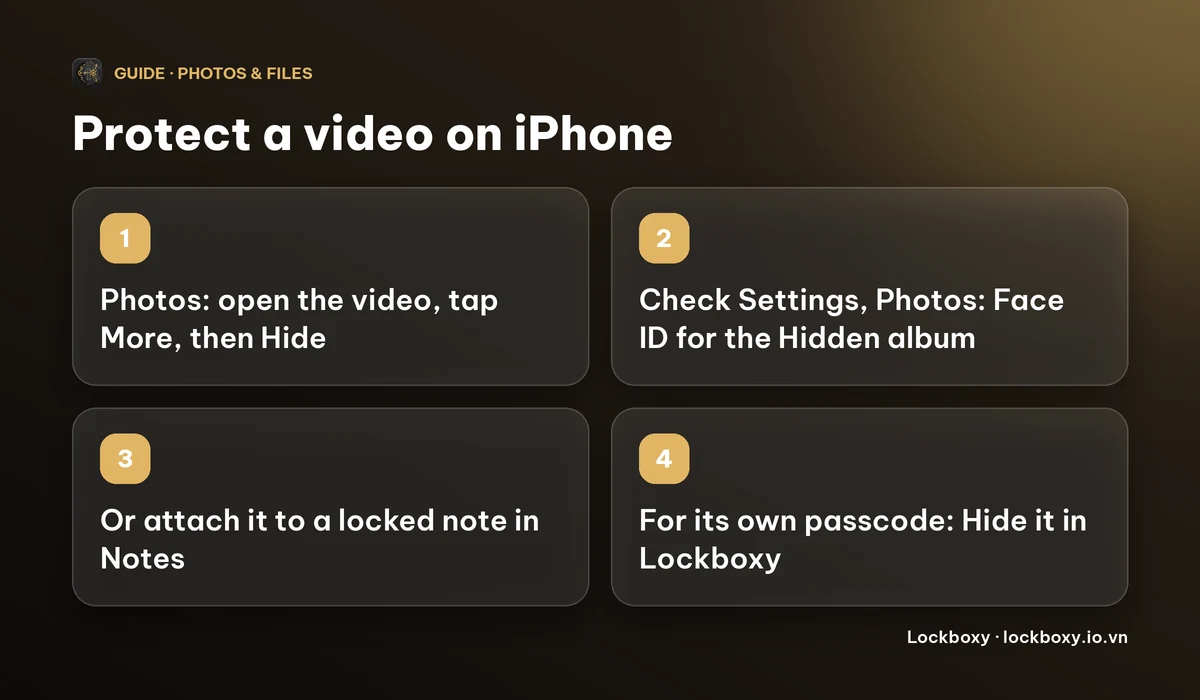
- 1Open Photos and open the video.
- 2Tap the More button (three dots), then Hide, and confirm Hide Video. You can also touch and hold a video in the grid and choose Hide.
- 3The video moves out of your main library and into the Hidden album: Albums, then Utilities, then Hidden.
- 4On iOS 16 and later the Hidden album is locked with Face ID, Touch ID or your passcode. Check it under Settings, then Photos, and you can also turn off Show Hidden Album so it disappears from the album list. See how to find the Hidden album on iPhone if it is missing.
Anyone who knows your iPhone passcode can open the Hidden album, and an iCloud Photos library syncs it to your other devices. How to hide photos on iPhone explains what hidden really means.
How do I lock a video inside a note?
- 1In Notes, create a new note and tap the paperclip or camera button.
- 2Choose Photo Library or Choose Photo or Video, and pick the video.
- 3Tap More, then Lock, and set a password for notes or use Face ID.
- 4Lock the note. The video is now only visible after unlocking.
The note keeps its own copy, but the original is still in Photos until you delete it. Long videos make a note heavy and slow to open, so this suits short clips. Details are in how to lock notes on iPhone.
How do I keep a video in a vault with its own passcode?
If you want a passcode that is separate from your iPhone passcode, Lockboxy is an iPhone app that stores photos, videos and files in an encrypted vault.
- 1Open Lockboxy and unlock it with its passcode.
- 2Go to Media, tap +, pick the video and choose Hide.
- 3iOS shows its own confirmation before the original is removed from your Photos library. Confirm it if you want the video to leave the library.
- 4Open the video from Media for full-screen playback. To put it back, select it and tap Unhide.
You can also share a video into Lockboxy from Photos, Files or another app through the Share Sheet.
What is different about a vault?
Videos in Lockboxy are encrypted with AES-256 on your device, and the vault key comes from the Lockboxy passcode, not from your iPhone passcode. The videos do not appear in the Photos app, in Memories or in search. There is no account and no server holding a copy, and the vault works offline.
That also means there is nothing to recover from for us: if you forget the passcode, nobody can open the vault unless you made a Recovery Key (Premium) beforehand.
How do I remove the leftover copy of the video?
Whichever option you choose, the original may still be in your library, Recently Deleted or an iCloud backup. Check these:
- 1In Photos, delete the original if you moved the video elsewhere.
- 2Open Albums, then Recently Deleted, and delete it there too. Otherwise it stays for up to 30 days. See how to permanently delete photos on iPhone, which also applies to videos.
- 3Check chats and cloud services you may have shared the video through, since those copies are not touched.
What are the limits?
- Hidden album and locked notes protect against casual viewing, not against someone who knows your iPhone passcode.
- Nothing here deletes copies you already sent to other people or apps.
- Videos are large. A vault copy uses storage on your phone like any other file, so move only what needs protecting.
- The free plan has room for up to 30 photos or videos and 10 files. The price of Premium is shown in the app before you buy; see the Premium page.
- Apple can rename menus between iOS versions. If a step does not match your screen, use Search in Settings.
Frequently asked questions
Can you password protect a video on iPhone?
Not the video file itself. You can hide it in Photos so it needs Face ID or your passcode, lock it in a note, or keep it in an app like Lockboxy that has its own passcode.
Is the Hidden album safe for a private video?
It keeps the video out of the main library and asks for Face ID, Touch ID or your passcode on iOS 16 and later. Anyone who knows your iPhone passcode can still open it.
Does hiding a video delete the original?
In Photos, Hide moves it to the Hidden album. When you move a video into Lockboxy, iOS asks you to confirm removing the original from your library, and it then sits in Recently Deleted for up to 30 days.
Can I get the video back out of Lockboxy?
Yes. Select the video in Media and tap Unhide. It is decrypted and written back to your Photos library.
What if I forget the Lockboxy passcode?
Nobody, including us, can open the vault, unless you created a Recovery Key (Premium) beforehand. Keep the passcode or the key somewhere safe.
Want a private place with its own passcode?
Lockboxy encrypts photos, videos, files and notes on your device, behind a passcode separate from your phone's. No account, no server.
Get Lockboxy on the App StoreMore guides
- How to hide photos on iPhone (and what “hidden” really protects)
- How to find the Hidden album on iPhone (and why it may be missing)
- How to lock notes on iPhone with a password or Face ID
- How to permanently delete photos on iPhone (and every copy you forgot)
- How to lock apps on iPhone: Face ID lock, hiding apps and older-iOS workarounds
- How to store photos of your ID safely on your phone
- How to store passwords safely on your phone
- How to lend your iPhone without exposing your photos
- How to store a seed phrase safely (and what not to do)
- What to do before sending your iPhone for repair
- How to take photos that don't save to your iPhone camera roll
- How to scan documents on iPhone (no app needed) and store them safely
- How to store 2FA backup codes safely (and where not to)
- How to handle sensitive screenshots on iPhone (bank transfers, OTPs, IDs)
- How to keep voice recordings private on iPhone
- How to stop iPhone photos syncing to your iPad and Mac
- What to do when your iPhone is lost or stolen
- How to erase your iPhone before selling it
- Lockboxy vs the iPhone Hidden album: which should you use?
- Lockboxy vs locked notes on iPhone: which is better for private notes?
- Phone privacy for livestream sellers: keep customer data off the stream
- Keeping client documents private: a phone routine for real-estate agents
- How to hide contacts on iPhone: what really works
- How to tell if someone went through your iPhone
- How to move private photos to a new iPhone
- How to password protect a folder on iPhone
- How to remove location data from photos on iPhone before sharing
- How to store bank card details safely on your phone
- How to find and share a saved Wi-Fi password on iPhone
- How to stop unwanted photos from showing up in Memories and Featured Photos on iPhone
- How to control which photos an app can access on iPhone
- How to show someone a photo on your iPhone without them swiping to the others
- How to stop WhatsApp saving photos to your iPhone camera roll
- How to stop photos from Messages showing up in your iPhone Photos app
- How to password protect a PDF on iPhone
- What does Private Browsing on iPhone actually hide?
- Where do downloads go on iPhone? How to find, move and delete them
- How to hide private content in the iPhone App Switcher
- How to back up your iPhone photos without iCloud
- How to stop photos from showing up in iPhone Spotlight search
- What can someone do with your locked iPhone? How to limit Lock Screen access
- Why is there a green or orange dot on my iPhone? How to see which app is using your camera or microphone
- How to keep a private journal on iPhone
- How to stop unwanted AirDrops on iPhone
- How to keep medical documents and insurance cards private on iPhone
- How to change or remove the camera button on the iPhone Lock Screen
- Forgot the passcode of your private photo vault app? What you can and can't recover
- What happens to your iPhone photos and private data when you die? How to set up a Legacy Contact
- You copied a password on iPhone: who can see your clipboard, and how to stop apps pasting from it
- What is Stolen Device Protection on iPhone, and should you turn it on?
- Where to store PIN codes and door codes on iPhone
- How to share a password with family on iPhone without sending it in a chat
- Where to store your Apple Account recovery key (and what if you lose it)
- How to see saved passwords on iPhone (and what to do when one is missing)
Questions about how Lockboxy works? Read the FAQ