
What is Stolen Device Protection on iPhone, and should you turn it on?
Published November 2, 2026
A thief who watches you type your iPhone passcode used to be able to change your Apple Account password and lock you out within minutes. Stolen Device Protection, added in iOS 17.3, is Apple's answer: away from familiar places, the passcode alone is no longer enough for the most sensitive changes.
This guide explains what it does, how to turn it on, why it sometimes makes you wait an hour, and what it does not cover. Menu names and defaults can differ between iOS versions, so check your own screen if a label is different.
What does Stolen Device Protection actually do?
It adds extra checks when your iPhone is somewhere it does not recognise as a familiar location, such as home or work. There are two layers:
- Face ID or Touch ID with no passcode fallback. For actions like viewing saved passwords or passkeys, or using saved payment methods, a thief who knows your passcode still cannot continue without your face or fingerprint.
- A Security Delay of one hour plus a second biometric check. This applies to the most critical changes, such as changing your Apple Account password, changing the iPhone passcode, or turning off Find My or Stolen Device Protection itself. You authenticate, wait an hour, then authenticate again.
The hour is the point: it gives you time to mark the phone lost and secure your Apple Account from another device. Your iPhone can end the delay early if it detects you have reached a familiar location.
What do I need before I can turn it on?
Apple lists these requirements: iOS 17.3 or later, two-factor authentication for your Apple Account, a passcode, Face ID or Touch ID set up, Find My turned on, and Location Services with Significant Locations enabled (that is how the iPhone learns what counts as familiar).
On newer iOS versions, Apple may switch it on for you during setup. Check the setting rather than assuming, because it only helps if it was already on before the phone was stolen.
How do I turn on Stolen Device Protection?
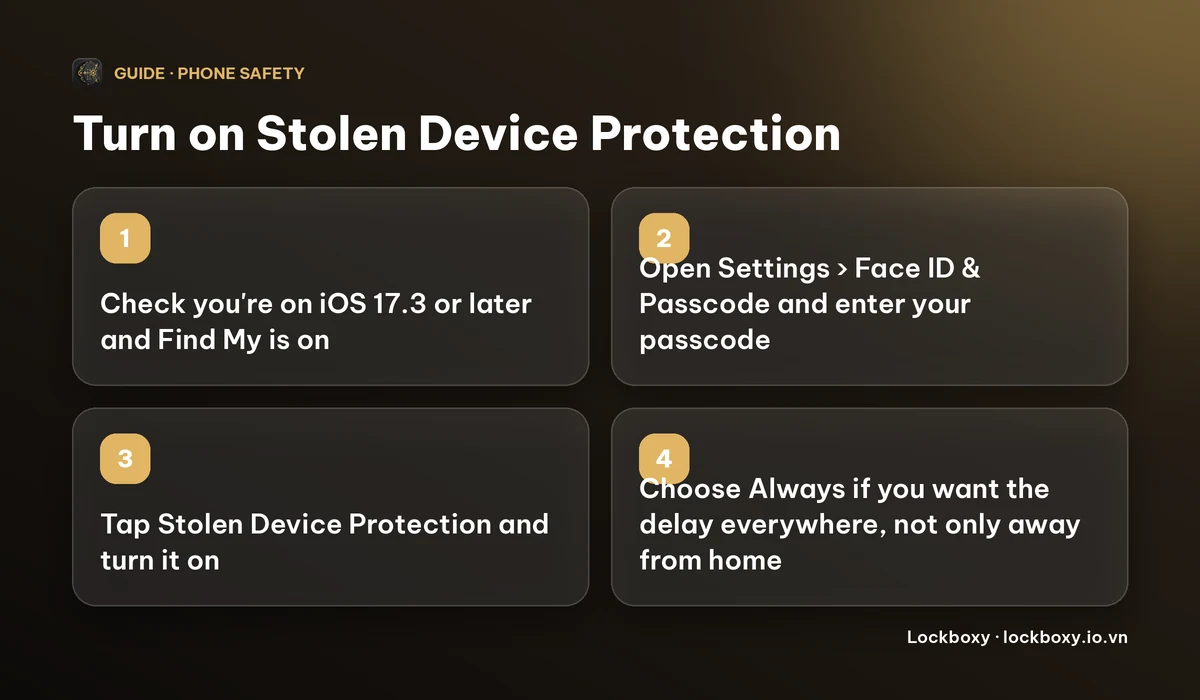
- 1Open Settings and tap Face ID & Passcode (Touch ID & Passcode on phones with Touch ID). Enter your passcode.
- 2Tap Stolen Device Protection and turn it on.
- 3Under Require Security Delay, the default is Away from Familiar Locations. Choose Always if you want the delay everywhere, including at home. It is stricter and slightly less convenient.
If you cannot see the option, update iOS first. If Find My or Significant Locations is off, turn them on and look again.
Why does my iPhone make me wait an hour, and can I skip it?
If you try one of the protected changes away from a familiar location, you will see a Security Delay message. You cannot skip it with the passcode, which is the whole design. At a familiar location the delay does not apply, so it is usually just a Face ID or Touch ID check.
If you are locked out of a protected action because Face ID is not working, fix that first (for example by resetting Face ID at home), or go to a familiar place and try again.
Turn Stolen Device Protection off before you sell or trade in an iPhone, because it also guards Erase All Content and Settings. If you try to turn it off away from home, the Security Delay applies to that too. See How to erase your iPhone before selling it.
What does it not protect?
- It does not stop someone using what is already visible on an unlocked phone, or on a Lock Screen with generous settings. See What can someone do with your locked iPhone?.
- It does not find or lock the phone for you. After a theft you still need to use Find My and Lost Mode. See What to do when your iPhone is lost or stolen.
- It does not cover a thief who has your Apple Account password and a trusted device, or who watches you unlock with your face.
- It does not encrypt anything extra inside your apps. Photos and documents in apps are protected only by what that app does.
Where does Lockboxy fit?
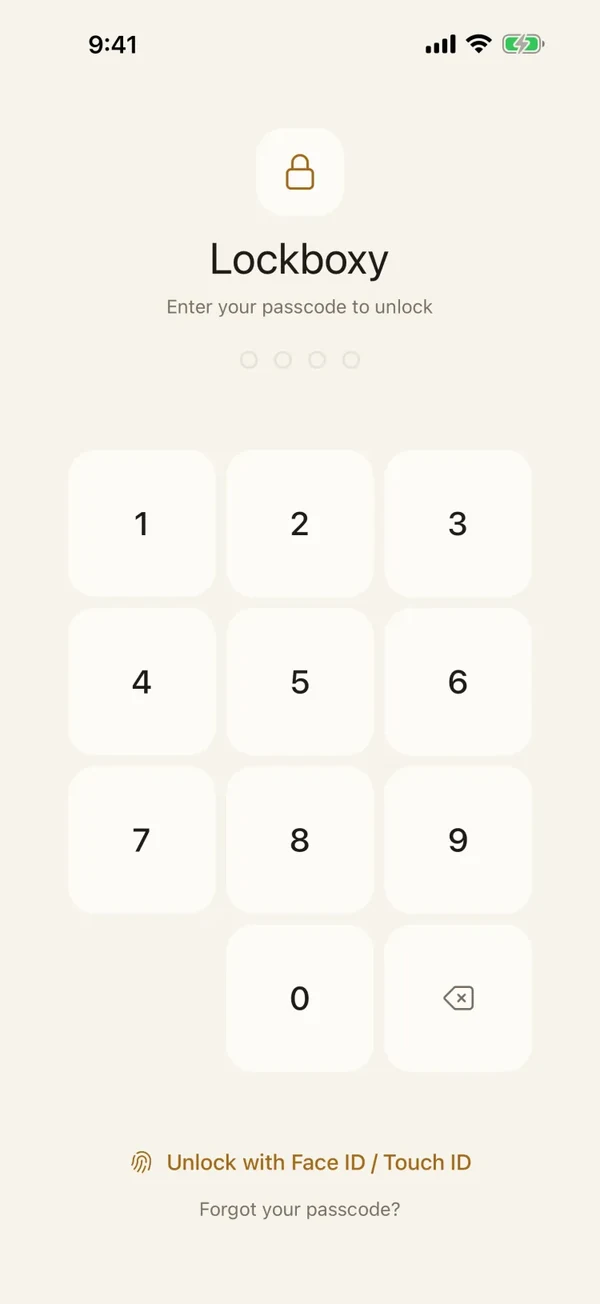
Lockboxy is an iPhone app that keeps photos, files, notes and passwords in an encrypted vault behind its own passcode, with Face ID as an option. That passcode is separate from your iPhone passcode. If someone learns your iPhone passcode, the vault still asks for a passcode they have not seen, and each wrong attempt makes them wait longer.
The vault also locks again after 1 minute without a touch. This works alongside Stolen Device Protection, not instead of it: Apple's feature protects your accounts and settings, and Lockboxy protects what you keep in the vault.
Lockboxy has no account and no server, so it cannot locate or lock a stolen phone, and it cannot restore a vault you lose. Keep a backup somewhere you control if the contents matter.
Frequently asked questions
What is Stolen Device Protection on iPhone?
A feature added in iOS 17.3 that requires Face ID or Touch ID, and for the most critical changes a one-hour Security Delay, when your iPhone is away from familiar locations such as home or work.
How do I turn on Stolen Device Protection?
Go to Settings → Face ID & Passcode (or Touch ID & Passcode), enter your passcode, tap Stolen Device Protection and turn it on. You need iOS 17.3 or later, Find My and Significant Locations on, and two-factor authentication.
Why can't I change my Apple Account password or turn off Find My?
Away from a familiar location, these actions need Face ID or Touch ID, a one-hour Security Delay, then a second check. Wait it out or go to a familiar place such as home.
Should I turn it off before selling my iPhone?
Yes. Turn it off, then erase the phone. Do it at home, otherwise turning it off triggers the Security Delay.
Does Lockboxy replace Stolen Device Protection?
No. They protect different things. Stolen Device Protection guards your Apple Account and iPhone settings, and Lockboxy's own passcode guards what is inside the vault.
Want a private place with its own passcode?
Lockboxy encrypts photos, videos, files and notes on your device, behind a passcode separate from your phone's. No account, no server.
Get Lockboxy on the App StoreMore guides
- What to do when your iPhone is lost or stolen
- What can someone do with your locked iPhone? How to limit Lock Screen access
- How to erase your iPhone before selling it
- How to hide photos on iPhone (and what “hidden” really protects)
- How to lock apps on iPhone: Face ID lock, hiding apps and older-iOS workarounds
- How to store photos of your ID safely on your phone
- How to permanently delete photos on iPhone (and every copy you forgot)
- How to lock notes on iPhone with a password or Face ID
- How to store passwords safely on your phone
- How to lend your iPhone without exposing your photos
- How to store a seed phrase safely (and what not to do)
- What to do before sending your iPhone for repair
- How to take photos that don't save to your iPhone camera roll
- How to scan documents on iPhone (no app needed) and store them safely
- How to store 2FA backup codes safely (and where not to)
- How to handle sensitive screenshots on iPhone (bank transfers, OTPs, IDs)
- How to keep voice recordings private on iPhone
- How to stop iPhone photos syncing to your iPad and Mac
- Lockboxy vs the iPhone Hidden album: which should you use?
- Lockboxy vs locked notes on iPhone: which is better for private notes?
- Phone privacy for livestream sellers: keep customer data off the stream
- Keeping client documents private: a phone routine for real-estate agents
- How to hide contacts on iPhone: what really works
- How to tell if someone went through your iPhone
- How to move private photos to a new iPhone
- How to password protect a folder on iPhone
- How to remove location data from photos on iPhone before sharing
- How to store bank card details safely on your phone
- How to find and share a saved Wi-Fi password on iPhone
- How to stop unwanted photos from showing up in Memories and Featured Photos on iPhone
- How to control which photos an app can access on iPhone
- How to find the Hidden album on iPhone (and why it may be missing)
- How to show someone a photo on your iPhone without them swiping to the others
- How to stop WhatsApp saving photos to your iPhone camera roll
- How to stop photos from Messages showing up in your iPhone Photos app
- How to password protect a video on iPhone
- How to password protect a PDF on iPhone
- What does Private Browsing on iPhone actually hide?
- Where do downloads go on iPhone? How to find, move and delete them
- How to hide private content in the iPhone App Switcher
- How to back up your iPhone photos without iCloud
- How to stop photos from showing up in iPhone Spotlight search
- Why is there a green or orange dot on my iPhone? How to see which app is using your camera or microphone
- How to keep a private journal on iPhone
- How to stop unwanted AirDrops on iPhone
- How to keep medical documents and insurance cards private on iPhone
- How to change or remove the camera button on the iPhone Lock Screen
- Forgot the passcode of your private photo vault app? What you can and can't recover
- What happens to your iPhone photos and private data when you die? How to set up a Legacy Contact
- You copied a password on iPhone: who can see your clipboard, and how to stop apps pasting from it
- Where to store PIN codes and door codes on iPhone
- How to share a password with family on iPhone without sending it in a chat
- Where to store your Apple Account recovery key (and what if you lose it)
- How to see saved passwords on iPhone (and what to do when one is missing)
Questions about how Lockboxy works? Read the FAQ